


The Kyokushin Dogi: Built for Contact, Kept With Respect
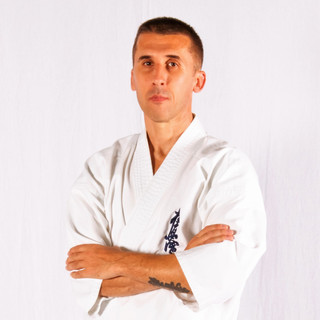
Every class starts the same way. You put on your dogi, tie your belt, and step onto the mat. It's the one piece of equipment you wear every single session, and it's a lot more than a workout uniform. It isn't casual sportswear and it isn't a costume.
The dogi carries the history of Kyokushin and the effort of everyone who wore one before you. Putting it on means you've agreed to work honestly and respect the people training next to you. It's also real working gear, built to hold up to full-contact karate, and that's what shaped the way it's made.
A Kyokushin dogi, sometimes called a Kyokushin karate gi, has a heavy canvas jacket, wider and lighter pants, and shorter sleeves. Here's why it's built that way, and how we expect our students to look after it.

Why Is the Kyokushin Dogi Different From Other Karate Uniforms?
Traditional martial arts uniforms weren't made for knockdown fighting. Light cotton tore under constant pressure, long sleeves got tangled in close exchanges, and tight pants got in the way of high kicks.
Sosai Masutatsu Oyama, the founder of Kyokushin Karate, worked with Isami, the Japanese uniform maker, to fix that and develop a dogi that could take the daily punishment of Kyokushin training. Sosai tested the heavy uniforms himself, and he liked unbleached canvas, the natural cream color of raw cotton. It started out stiff, then softened with sweat and age until it fit the person wearing it. He often passed his well-worn dogis on to his students as a sign of hard work and dedication.
That preference is still around today. Bright white bleached dogis are the more common sight, and there's nothing wrong with one. But plenty of fighters choose unbleached once they've trained for a while. Many feel it holds up better to hard use, and it doesn't show its age the way bright white does. After a year or two of real training, an unbleached dogi looks lived in instead of just dirty, which suits a style where the uniform is meant to be used hard.
How Is a Kyokushin Dogi Cut?
A Kyokushin dogi has a heavy canvas jacket, wider and lighter pants, and sleeves cut shorter than most karate uniforms. Every part of the cut has a reason behind it.
The pants are wider and longer, made from a lighter cotton twill. That gives you room in the hips and knees, so you can drop into a low stance or throw a head kick without the fabric catching or dragging.
The jacket is the opposite. It's made from heavy, dense cotton canvas that absorbs impact and holds up through clinch work and infighting without tearing. It's cut long in the body so it stays tucked under your belt during kumite instead of riding up. The sleeves are cut shorter, around three-quarter length on the forearm. That keeps the cuffs off your wrists, which helps your hand speed, and gives an opponent less to grab in close quarters.
Is a Good Dogi Worth the Money?
Yes. A cheap, low-grade uniform soaks up sweat, sticks to your skin, and restricts how you move. It usually starts coming apart at the seams within a few months of sparring. A good heavyweight dogi keeps its shape, breathes properly, and protects your skin during hard contact.
If you're training several days a week at an intermediate or advanced level, you should own at least two. A heavy canvas dogi needs time to be washed and dry out fully between classes. Putting on a damp one wears down the fabric, breeds bacteria, and leaves a smell that doesn't go away. With two good uniforms in rotation, you always show up dry and fresh, and you never have to rush the laundry.

How Should You Take Care of Your Dogi?
Wash it when needed and let it dry fully before you wear it again. At Contact Kicks Martial Arts, we expect students to keep their dogi clean, because how you treat it away from the dojo says a lot about you as a martial artist. Don't let sweat build up or stains set in. At home, don't throw it on the floor or leave it crumpled in a gym bag. Hang it up, or fold it neatly and put it on a shelf.
If a seam starts to pull or a collar starts to fray, don't toss it and don't ignore it. Take a needle and thread and fix it yourself. In traditional Japanese karate culture, mending your own uniform is part of staying connected to the time and sweat you've put into your training. A neatly patched dogi shows commitment. A dirty or torn one that nobody bothered to fix shows the opposite.
What the Dogi Stands For
Remember what you're wearing. When you put on your dogi and tie your belt, carry yourself with humility and respect for everyone in the room. It stands for discipline and honest effort. Look after it, wear it with pride, and let your training do the talking.
— Shihan Steve and Senpai Mici, Contact Kicks Martial Arts


Comments